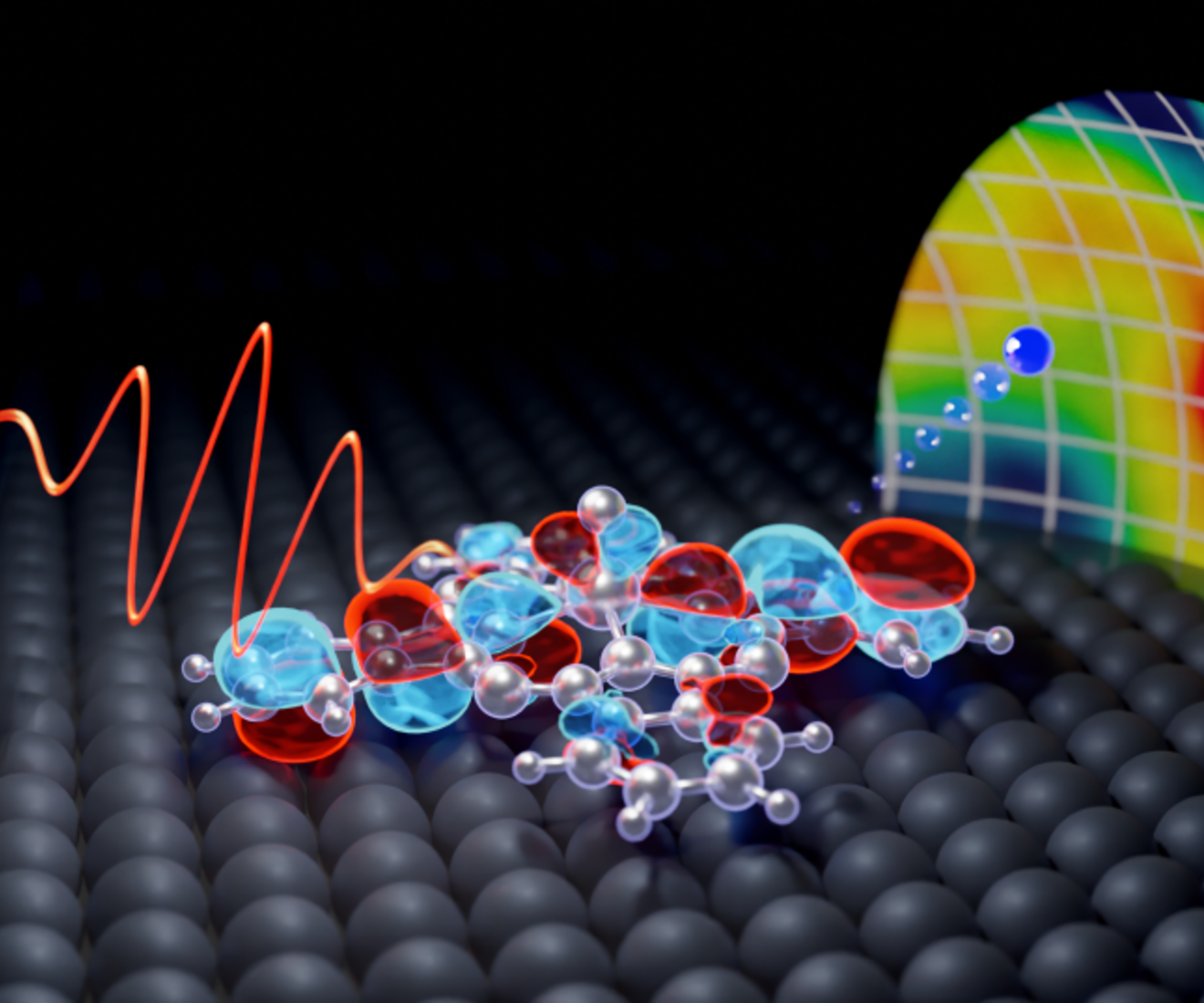
A chiral molecular structure made headlines in the 1960s as the thalidomide scandal. Thalidomide was administered to pregnant women as a medication and caused massive birth deformities in newborns. “Chiral molecules exist in two forms that differ in their spatial orientation. It's comparable to the right and left hand,” explains Diana Shakirova. One type can have a healing effect, the other a toxic one. This is a significant difference, as these compounds play an important role in both the food industry and medicine, as the doctoral student in solid-state physics emphasises: “My goal is to design a nanostructure onto which we can insert chiral molecules, illuminate them with light and use the signal to define about their effect.”
Photonic Integrated Circuits
Christoph Stockinger's field of research also has the potential to shed light on new discoveries. The physics doctoral student is working on so-called photonic integrated circuits, which use light to transmit data. “The technology is used in the field of camera sensors,” Stockinger cites as an example. As part of his dissertation, he is attempting to build a sensor for free-space light that detects various parameters of light. “Conventional camera sensors can distinguish between light and dark and indicate the colour of light. But there are other parameters, such as the polarisation of light, as we know from sunglasses.” Christoph Stockinger is currently investigating whether this can also contain information – for example, when light shines on biological tissue.
NanoGraz Careers & Ideas Days
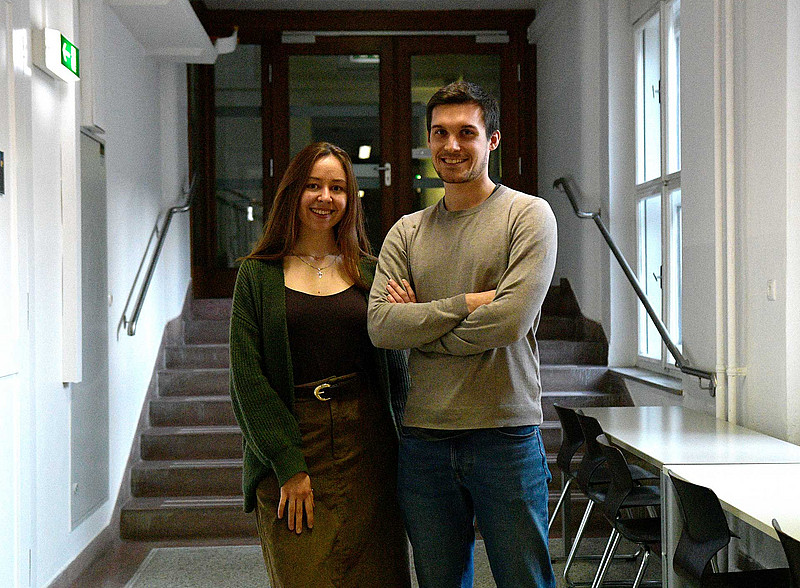
While Stockinger is in his second year of doctoral studies, Diana Shakirova plans to graduate in 2026. Despite being at different stages in their careers, both are thinking about their professional future and took part in NanoGraz Careers & Ideas Days 2025.
“Many of our doctoral students will be completing their education in the near future. So it made sense to organise an event to show them their options after completing their doctorates,” say Thomas Weiss and Peter Banzer, the two spokespersons for NanoGraz, explaining the initiative as part of the Research Career Campus at the University of Graz. “We wanted to create real added value for the next generation.” An idea that paid off, as Shakirova and Stockinger confirm.
Room for creativity
“On the one hand, representatives from companies provided interesting insights. On the other hand, it was helpful to exchange ideas with colleagues from the fields of pharmacy, biology and chemistry,” the physicist summarises her impressions. After completing her doctorate, she would like to continue in research: “Science gives you room for creativity. I also enjoy passing on my knowledge to students.”
Christoph Stockinger was pleased to hear during the two-day event that his expertise is in high demand in industry. “The speakers confirmed that there is a need for us basic research experts.”
The two young scientists look just as optimistic as they gaze out of their office at the construction of the Graz Centre of Physics. “It will make infrastructure, such as the shared use of equipment, much easier and intensify cooperation, because communication also happens in the corridor.” And it may even become their future workplace.