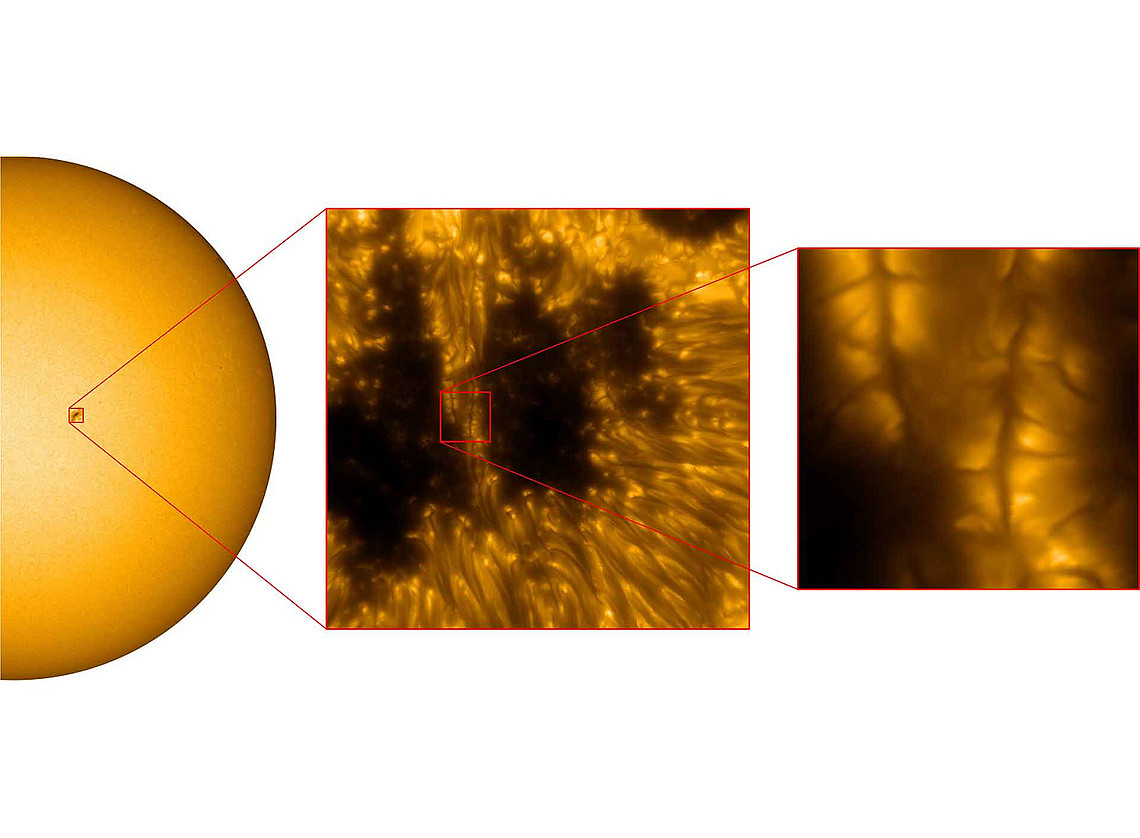
The Daniel K. Inouye Solar Telescope in Hawaii is currently the world’s largest solar telescope and provides spectacular, high-resolution images of the Sun. “These images give us insight into the dynamic processes of the solar plasma and magnetic field,” explains Astrid Veronig, astrophysicist and head of the research group at the University of Graz. “However, the Earth’s atmosphere poses a challenge, as turbulence significantly impairs image quality. As a result, fine details on the Sun’s surface often appear blurred or even unrecognisable. Even adaptive optics and traditional reconstruction methods cannot reproduce these small-scale structures with full sharpness.”
The international team has now solved this problem with the help of artificial intelligence. The method combines expert physical knowledge with the power of machine learning. “Our AI is not simply a black box,” emphasises Astrid Veronig. “It uses physical models and equations describing how light and the atmosphere interact, and can thus separate the image information from atmospheric disturbances and reconstruct the image.”
Tiny structures made visible
Christoph Schirninger, a PhD student at the University of Graz and lead author of the study, first tested the procedure using simulation data. The method was then applied to real observational data – with resounding success. “Tiny structures that were previously hidden could thus be made visible,” explains Schirninger.
“Physics-informed neural networks open up entirely new perspectives for solar research. In the long term, this technology could revolutionise image reconstruction for future large telescopes,” adds Robert Jarolim, a researcher and NASA Jack Eddy Fellow at the High Altitude Observatory in Boulder.
⇒ The study was published in the journal Astronomy & Astrophysics.