The conversion of light into electricity is a key technological process, for solar cells as well as for the image sensors in our cameras. As in other fields, research in this area has now progressed to the investigation of nanostructures. This allows the underlying elementary processes to be studied, thus laying the foundation for following technology generations.
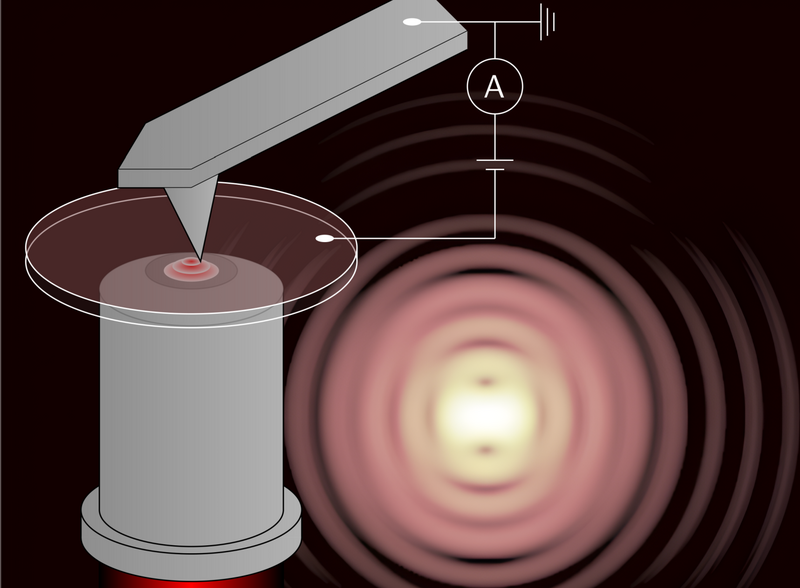
The Nanooptics research group works, among other things, on semiconducting nanoparticles, so-called quantum dots. In recent years, they have not only been able to clarify open questions regarding light-induced currents in quantum dots. With atomic force microscopy, they have also adapted a high-resolution imaging method so that a conductive probe tip delivers current measurements with a spatial resolution of a few nanometers.
Work on monolayers of lead sulfide quantum dots (provided by the project partner at ETH Zürich) showed that this experimental approach also makes it possible to image light fields. The current through each individual quantum dot reflects the light intensity acting upon it. The high-quality monolayer and the resolution of the atomic force microscope enable high-resolution imaging. This was demonstrated using the focus of a microscope objective with a high numerical aperture and the light field around regularly arranged plasmonic nanoparticles. In both cases, numerical simulations confirmed the experimental data.
F. Küstner, A. Hohenau, H. Ditlbacher, J. R. Krenn, Quantum-dot-mediated light field imaging by photocurrent scanning force microscopy, Nanophotonics 15, e70057 (2026)
https://doi.org/10.1002/nap2.70057