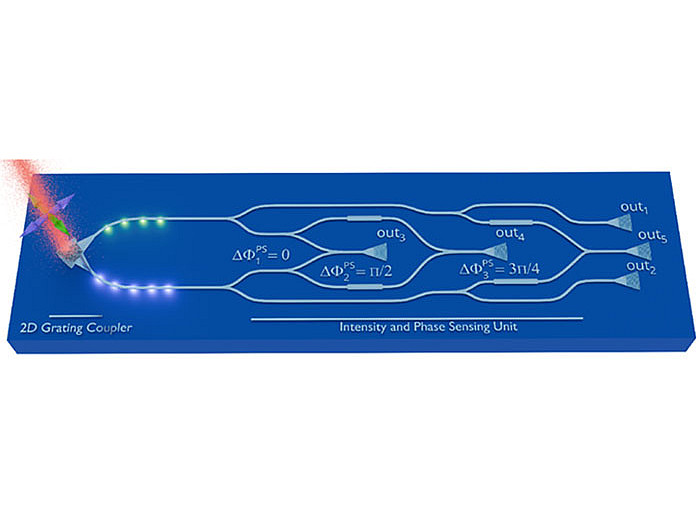
At the heart of the on-chip polarimeter is a compact polarization‑splitting grating coupler that directs two linear polarization components into separate waveguides on the chip. These signals are then analyzed by a network of passive interferometers, allowing the full polarization state to be reconstructed using only intensity measurements; no moving parts, modulators, or active tuning required.
Because extreme miniaturization can make such components less performant and sensitive to deviations, the researchers introduced a robust calibration method that compensates for imperfections in the polarization splitting capabilities of grating couplers, and fabrication tolerances of waveguides and phase shifters. Using a programmable polarization state generator, the chip can be fully calibrated, enabling highly accurate polarization measurements of arbitrary input states.
This advance paves the way for scalable, low‑cost, and fast polarimetric sensors, including future 2D detector arrays for imaging polarimetry in the visible spectrum.
Link to publication:
https://www.spiedigitallibrary.org/90f072ad-89a6-4d76-94a6-16ce92843e04
Contact:
Peter Banzer, peter.banzer(at)uni-graz.at
Additional links:
https://structured-matter.com/
https://opnaq.uni-graz.at/en/research/